|
Beauty is not enough. ͏ ͏ ͏ ͏ ͏ ͏ ͏ ͏ ͏ ͏ ͏ ͏ ͏ ͏ ͏ ͏ ͏ ͏ ͏ ͏ ͏ ͏ ͏ ͏ ͏ ͏ ͏ ͏ ͏ ͏ ͏ ͏ ͏ ͏ ͏ ͏ ͏ ͏ ͏ ͏ ͏ ͏ ͏ ͏ ͏ ͏ ͏ ͏ ͏ ͏ ͏ ͏ ͏ ͏ ͏ ͏ ͏ ͏ ͏ ͏ ͏ ͏ ͏ ͏ ͏ ͏ ͏ ͏ ͏ ͏ ͏ ͏ ͏ ͏ ͏ ͏ ͏ ͏ ͏ ͏ ͏ ͏ ͏ ͏ ͏ ͏ ͏ ͏ ͏ ͏ ͏ ͏ ͏ ͏ ͏ ͏ ͏ ͏ ͏ ͏ ͏ ͏ ͏ ͏ ͏ ͏ ͏ ͏ ͏ ͏ ͏ ͏ ͏ ͏ ͏ ͏ ͏ ͏ ͏ ͏ ͏ ͏ ͏ ͏ ͏ ͏ ͏ ͏ ͏ ͏ ͏ ͏ ͏ ͏ ͏ ͏ ͏ ͏ ͏ ͏ ͏ ͏ ͏ ͏ ͏ ͏ ͏ ͏ ͏ ͏ ͏ ͏ ͏ ͏ ͏ ͏ ͏ ͏ ͏ ͏ ͏ ͏ ͏ ͏ ͏ ͏ ͏ ͏ ͏ ͏ ͏ ͏ ͏ ͏ ͏ ͏ ͏ ͏ ͏ ͏ ͏ ͏ ͏ ͏ ͏ ͏ ͏ ͏ ͏ ͏ ͏ ͏ ͏ ͏ ͏ ͏ ͏ ͏ ͏ ͏ ͏ ͏ ͏ ͏ ͏ ͏ ͏ ͏ ͏ ͏ ͏ ͏ ͏ ͏ ͏ ͏ ͏ ͏ ͏ ͏ ͏ ͏ ͏ ͏ ͏ ͏ ͏ ͏ ͏ ͏ ͏ ͏ ͏ ͏ ͏ ͏ ͏ ͏ ͏ ͏ ͏ ͏ ͏ ͏ ͏ ͏ ͏ ͏ ͏ ͏ ͏ ͏ ͏ ͏ ͏
Hello there!Ho ho — it might be the end of the month, but it’s still April, baby. If you’re new, welcome. If you’ve been here before, yay. To what purpose, April, do you return again?
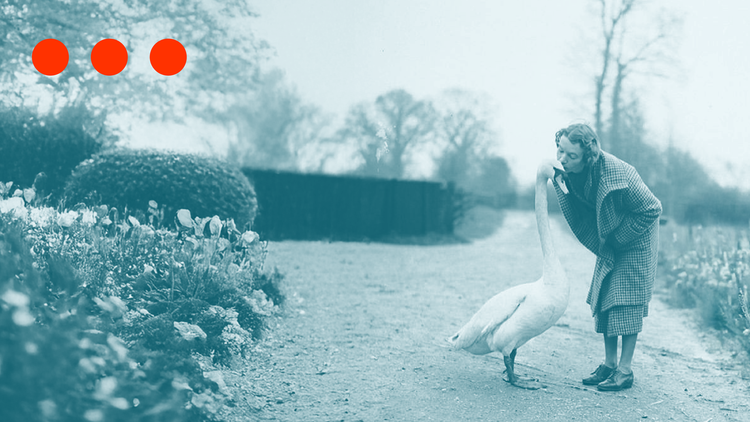
Beauty is not enough.
You can no longer quiet me with the redness
Of little leaves opening stickily.
I know what I know. — Edna St. Vincent Millay
Although Easter was approx 900 years ago, it did get me thinking about the English Bible. When we roll out the Greatest Hits of English, the usual headliners are Beowulf (Old English), Chaucer (Middle English) and Shakespeare (Modern English). But the King James Bible played a chunky role in standardising English and still influences how we speak today. We’ll touch on this, but for more thaumaturgical larks, check out The Adventure of English or The Making of the English Bible.
|
Meanwhile in editingI love learning highly specific terms from communities I’m adjacent to but not part of. I don’t mean obscure words that have only been documented once in the history of English (I’m looking at you, Henry Cockeram, with your “““latibulate”””) — I mean words that real people use, but which have such limited use-cases that they rarely breach containment. Catholicism is chock full of them, but my fave at the moment is transverberation.
|
|
transverberation /trænzvɜbəˈreɪʃən/ n. God’s love in the form of a dart, arrow or lance being thrust repeatedly into the heart of a saint. A wound of ecstatic love. AKA, ooft.
|
|
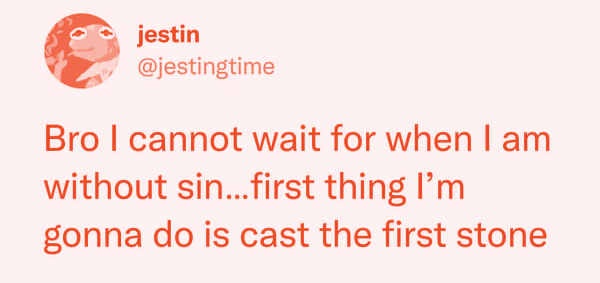
Equally delightful is discovering that a surprising number of words and phrases can be traced back to one very busy person. Often, that just means they were the first to write it down (the phrase itself may have been doing the rounds for years). But in the case of Wycliffe and Tyndale — two buluga-whale-foreheaded early translators of the Latin Vulgate Bible — these were the real deal. Their translations are responsible for such classics as: bite the dust the fly in the ointment double-edged sword take root scapegoat stumbling block cast the first stone
Thank you, boys. 🫡
|
Meanwhile in styleIt’s 2026. At any given moment, approximately 100,000 writers are producing identical thinkpieces defending the em dash in The Age of AI™. But the open-minded punctuation cognoscenti know that a dash is only one (and not necessarily even the best) way to slip a conversational aside into a sentence. Eagle-eyed readers will have noticed that my preference leans towards a pair of brackets — specifically, parentheses.
|
|
A parenthesis is one of these guys (). As a pair, they’re called rounded brackets or parentheses. Beloved plague-orphan Erasmus referred to them as lunula due to their crescent-moon shape (very girlypop of him). Rounded brackets are one of the four different brackets in English: Rounded brackets () Square brackets [] Curly brackets {} Chevrons ⟨⟩
Let’s start by agreeing that chevrons should be called triangle brackets. Happily, despite being the first brackets to show up in English, they’ve since been foisted off onto the maths dorks and are no longer our problem.
|
|
Square and curly brackets are both used in regular English, but they’re the more underground versions of their round cousins. The most common use for square brackets is to indicate omission or show where a word in a quote has been replaced by the person quoting, as in the eternally hilarious: Meanwhile is the [best] newsletter I have ever read. I […] love it.
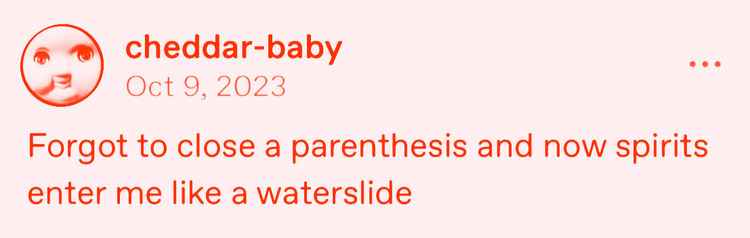
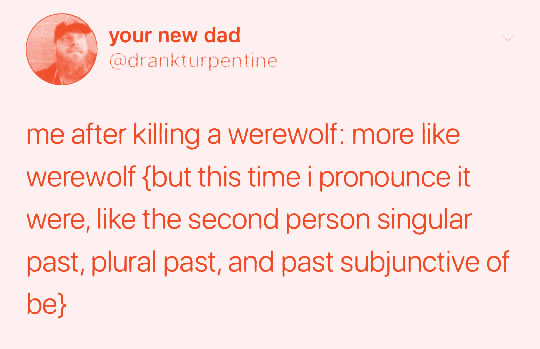
Curly brackets are most commonly used in editing, but they can also be used off-label to suggest italics or asides on platforms that don’t allow text formatting, as below.
|
|
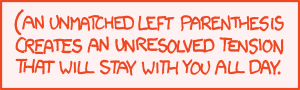
Em dashes are useful, but there’s something irresistibly conspiratorial in a parenthesis. An em dash gives the reader extra information, but a rounded bracket feels like leaning over to whisper something rude to your classmate. Use accordingly. 😘
|
Meanwhile onlineI couldn’t be less interested in the so-called ‘sentience’ of LLMs. In fact, I find the intellectual energy people spend on defending the concept fairly repellent, for reasons explored in marine ecologist Spencer Roberts’ article Why All Animals Are Sentient, And Machines Never Will Be: The idea of AI sentience remains trapped in the misguided paradigm of evaluating non-human intelligence by its resemblance to human behavior. It is sad that our society is so generous in considering the sentience of machines, yet so skeptical of other creatures. We sympathize with software that prints “I don’t want to die,” without bothering to learn the languages others use to make the same plea.
|
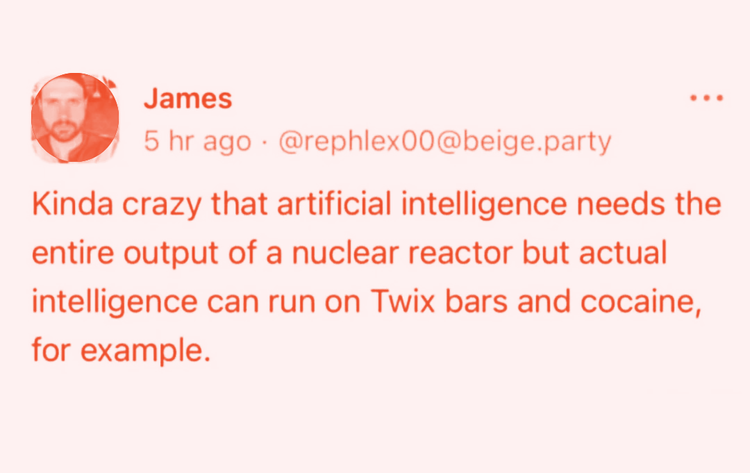
The whole pointApologies in advance for #SincerePosting, but I do hear this a lot: people are worried AI is getting a bit too good at sounding human, and they see this as a threat to writers (and readers). When you read that a 2024 study found most of us can’t tell classical poetry from AI outputs — and often prefer the latter — it’s grim! Spooky! Until you read the fine print: the participants weren’t especially well-versed (haw) in poetry, and they tended to prefer what was simpler and therefore easier to understand. This tracks to me! Even poetry lovers will admit the classics can be a bit inpenetrable without context or interest. It’s no surprise that folks resonated with the stuff they could understand first go.
|
|
It doesn’t really matter that AI can sound human. It will satisfy people like those who participated in the study, and that’s absolutely fine. They weren’t looking for the sort of writing we’re worried about losing in the first place. In the meantime, writers will keep writing because we need to write, just as runners will keep running despite the existence of perfectly good cars. The outputs might look similar, but they’re only cosmetically related. To have shared information and arrived at a destination are results. To write and to run are embodied experiences. It doesn’t matter that AI can sound human, because sounding human is not being human. Writing is a way of being human. The best human writing, the writing we want to protect, is unexpected and uncontrived — fortuitously the very opposite of what an LLM is designed to produce. And if AI’s still getting you down, I can’t recommend a better tonic than scouring old newspapers for treats. For example, please enjoy this perfect headline hat-trick from the St. Louis Post-Dispatch, 1908 (full story here).
|
Meanwhile in artThis month’s adverbial coda is silently, illustrated by the talented and introspective Tho of To Moi Studio. Tho’s digital watercolour was inspired by her trip back to Vietnam, her complex feelings about home and the peace she experienced in the chaos of Saigon. A longing to wander tears my heart when I hear trees rustling in the wind at evening. If one listens to them silently for a long time, this longing reveals its kernel, its meaning. — Herman Hesse
|
That’s all for AprilThanks for reading Meanwhile in April! If you were sent this and fancy subscribing, you can do so below — feel free to share it far and wide or keep it squirrelled away just for you. I’ll see you soon in May. 🫶
|
|
|
|